There are many examples in crime fiction where the main character isn’t a police officer. From Sherlock Holmes, a consultant detective, who worked mainly for his own mental stimulation and love of solving puzzles, to an amateur sleuth such as Miss Marple, whom I focused on in a previous newsletter. Nothing could be further from the little old lady who lived in St Mary Mead, as Los Angeles-based investigative crime journalist Jack McEvoy. I have recently finished reading Michael Connelly’s The Scarecrow, have previously read The Poet and look forward to reading Fair Warning, all which feature McEvoy as the main protagonist and look at crime from a different angle. It is one Connelly is well-placed to write, as he was a crime journalist himself, even working on the Los Angeles Times. His expert knowledge gives McEvoy’s newsroom and nose for a story a realistic background, alongside the backup of FBI Agent Rachel Walling. Of course, Connelly is well known for writing about LAPD Detective Harry Bosch, whom I will feature another time.
I have toyed with writing from the point of view of my antagonist from Deadly Justice, Jason Ridley, who is almost a vigilante, or the legal representatives Floyd Jesseck and Jim Smithies. Or maybe, my no-nonsense uniform inspector, Fiona Marshall. Watch this space.
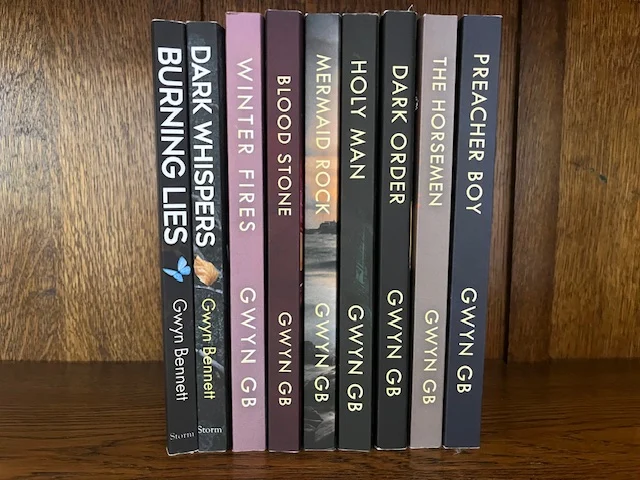
An author whom has helped me as I started to learn the ropes of self-publishing was Gwyn Bennett. One of her series follows Dr Harrison Lane, a psychologist, who heads up the UK police’s Ritualistic Behavioural Crime Unit. He uses his profiling and tracking skills to help the police catch those who hide behind religion, superstition, and folklore to create fear and commit crimes. Gwyn’s books are the ones on this month’s bookshelf, below, and you can check out her work here and there is a free novella introducing Harrison near the bottom of the page
It is interesting for the reader to follow an investigation from a different point of view, and often one that is not necessarily working parallel with the police, but against them. Which non-police protagonists do you like to read about? Reply to this email and let me know.
Can you trust the storyteller?
I like to celebrate milestones, and in a previous newsletter have written about Agatha Christie. It is now one hundred years since the publication of The Murder of Roger Ackroyd, an anniversary which is marked by this article by Adrian McKinty on crimereads.com
McKinty writes, ‘the novel forced writers and readers alike to confront a deeper question: who controls the story, and on what terms?’ This fits in nicely with the theme of this newsletter, as it is told from the point of view of Dr James Sheppard, the local physician and village doctor.
At the time, the plot was ground-breaking and led to much discussion and criticism. But any author yearns to write something that is still read and discussed a hundred years later. As McKinty says, ‘As the novel reaches its centenary in 2026, its power remains undiminished. The Murder of Roger Ackroyd endures because it respects its readers enough to challenge them—and because it reminds us that the most dangerous secrets are not hidden in dark corners, but spoken plainly, in voices we think we can trust.’